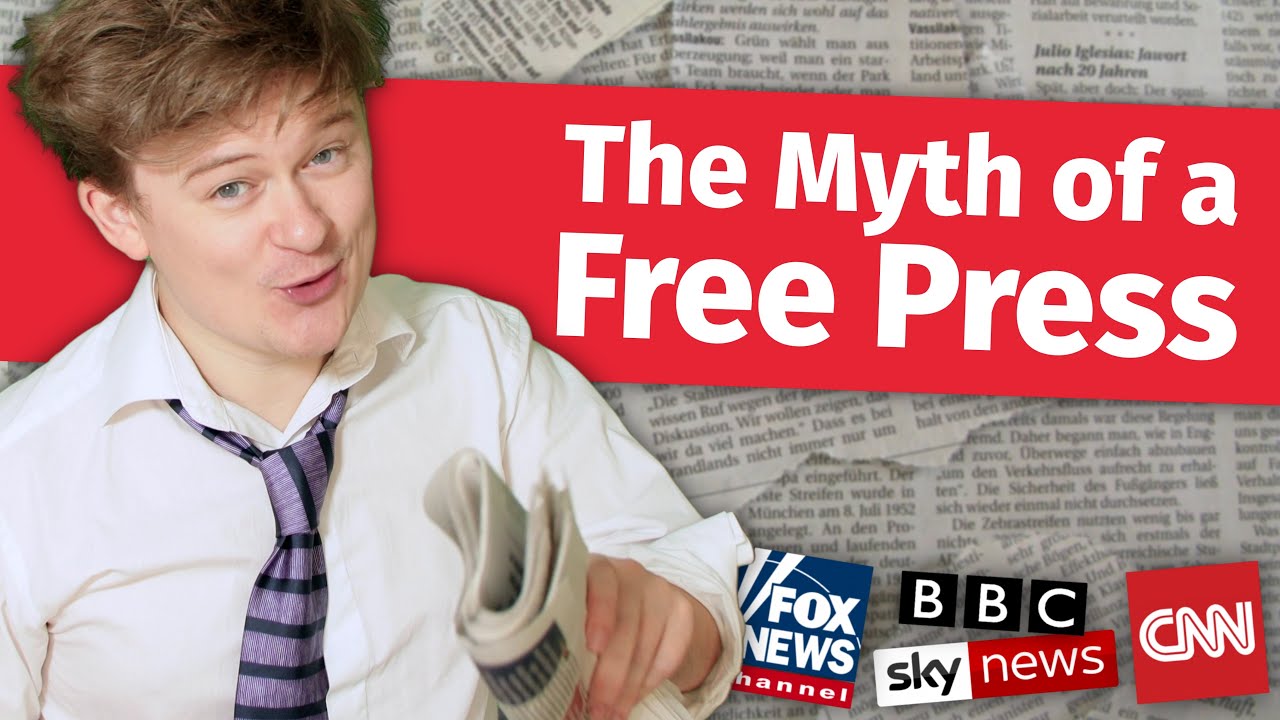
The Myth of a Free Press: Media Bias Explained

The video transcript provides a comprehensive analysis of media bias, focusing on how mainstream media in Western capitalist democracies, particularly the UK and the US, do not merely report events neutrally but actively shape the interpretation and meaning of those events. Using the BBC’s 2020 Newsnight report on the English Channel migrant crossings as a case study, the discussion draws heavily on the works of Edward S. Herman and Noam Chomsky’s Manufacturing Consent (1988) and cultural theorist Stuart Hall’s theories of media representation. The presenter challenges the assumption that media simply reflects reality, highlighting that news reporting is inherently biased due to economic, institutional, and political influences on media organizations.

The analysis explains how the BBC report frames asylum seekers as a threat and a problem rather than as vulnerable people in need of sympathy, largely omitting voices sympathetic to migrants or critical of government policy. This framing is attributed to various factors, including the BBC’s governance structure, political pressures from the Conservative government, and selective sourcing of interviewees predominantly hostile to migrants. The video further explains Herman and Chomsky’s five “filters” of media bias—ownership, advertising, sourcing, flak, and anti-communism—and applies these to the UK context, noting that while the BBC lacks advertising pressure, it remains influenced by government control and political appointments.

The transcript also explores the concept of “worthy” versus “unworthy” victims, showing how displaced Iraqis are framed differently depending on whether their suffering aligns with UK foreign policy interests. The video concludes by emphasizing that media bias is pervasive and systemic rather than random, serving the interests of economic and political elites, and encourages viewers to critically interrogate media coverage and the meanings it constructs rather than accepting it at face value.

What Happens to Workers When a Business Changes Hands?

When most people think about the future of a company, they picture executives, investors, or founders making major decisions at the top. Much less attention goes to the people whose livelihoods depend on those decisions every day. But when an owner retires, sells the business, or restructures the company, workers often bear the consequences just as directly as anyone else.

That is one of the key ideas behind Your Company Your Future. A company is not only a financial asset. It is also a workplace, a source of income, a piece of a local economy, and in many cases a community institution. When ownership changes, the outcome can mean stability and growth, or it can mean layoffs, relocation, and a loss of local control.

Too often, employees spend years helping build the value of a business without having much say in what happens next. They show up, build relationships with customers, preserve institutional knowledge, train new staff, and help keep the company running. Yet when the future of the company is decided, they may be treated as an afterthought.

This should concern more than just workers. It should concern communities as well. A business sale can reshape a town’s economic future. If ownership moves far away, decisions may become less rooted in local needs. Jobs can be consolidated. Wages can stagnate. A once-local company can become one more distant asset in someone else’s portfolio.

That does not mean every sale is harmful. Some transitions work well. But it does mean we should ask a bigger question: should the people who help create a company’s long-term value have a stronger voice in what happens to it?

This is where workplace reform becomes more than a debate about paychecks. It becomes a debate about power, stability, and shared responsibility. A healthier system would create more paths for workers to benefit from the businesses they help build. That could mean stronger worker representation, more support for employee ownership, better succession planning, or public policies that reward long-term stewardship instead of short-term extraction.

It also means we need to rethink what success looks like. A successful business should not be judged only by how profitable it is when sold. It should also be judged by whether it leaves workers, families, and communities stronger.

The future of work is not only about new jobs or better wages. It is also about who gets a say in the next chapter of the companies that shape our lives. If we want a better system, we need to make room for business models that treat workers not only as labor costs, but as stakeholders in the future.

A better workplace is not only one that pays fairly today. It is one that gives people a more secure stake in tomorrow.

What Does U.S. Health Care Look Like Abroad? | NYT Opinion

This video transcript effectively critiques the American healthcare system by juxtaposing it with international models. It challenges the narrative that healthcare is fundamentally a market commodity and instead frames it as a social good necessary for a functioning, equitable society. The personal stories woven into the discussion bring a human face to abstract policy debates, showcasing the real-world consequences of systemic failures.

The complexity of U.S. insurance plans is a significant barrier to care, with confusing acronyms and hidden costs that deter people from seeking treatment or lead to financial ruin. Countries like Canada demonstrate that a simpler, single-payer-like model can reduce this burden and improve health outcomes. This suggests that reform efforts should focus not only on expanding coverage but also on streamlining the system.

Universal healthcare is portrayed as a form of freedom—freedom from fear of financial catastrophe due to illness, and freedom to pursue meaningful work without sacrificing health coverage. This contrasts with the American model, where many are trapped in jobs solely to maintain insurance, stifling innovation and personal growth.

The pricing of pharmaceuticals, especially life-saving drugs like insulin, exemplifies the consequences of deregulated markets in healthcare. Government negotiation and price controls in other countries keep costs manageable and prevent rationing. The U.S.’s failure in this regard leads to tragic outcomes and raises ethical questions about access, equity, and capitalism’s role in healthcare.

The transcript also highlights the paradox of the U.S. healthcare system: it is the most expensive globally but does not deliver commensurate health outcomes. This disconnect suggests systemic inefficiencies, such as excessive administrative costs, high prices, and fragmented care delivery. It challenges policymakers to rethink incentives and structure to align spending with value.

Finally, the video addresses the ideological argument against universal healthcare as communism, showing that this is a political framing rather than an economic reality. Other wealthy nations successfully provide universal healthcare without sacrificing economic vitality, indicating that the U.S. resistance is more about political will and entrenched interests than feasibility.

In conclusion, the transcript advocates for a healthcare system that prioritizes human dignity, affordability, and universal access. It calls for regulatory reforms, simplification, and a shift in societal values towards seeing healthcare not as a privilege but as a fundamental right essential to freedom and well-being.